









As the school year begins, many parents find themselves focusing on the same things.
Did the homework get done?
Did they remember their backpack?
Did they put away their shoes?
Did they finish their chores without being asked?
It’s easy to think responsibility is something children suddenly develop as they get older. In reality, responsibility is a habit, and like any habit, it has to be practiced.
That’s why Responsibility is our Word of the Month at Freedom Martial Arts.
Responsibility Isn’t About Being Perfect
When children hear the word “responsibility,” they often think it means never making a mistake.
That’s not what we teach.
Being responsible doesn’t mean you always get everything right. It means you’re willing to own your choices, learn from them, and try again.
If a student forgets a piece of equipment, we don’t expect perfection. We expect them to remember it next time.
If they lose focus during class, we help them refocus instead of dwelling on the mistake.
Responsibility isn’t about avoiding failure.
It’s about learning how to respond to it.
That’s a skill they’ll use for the rest of their lives.
The Little Things Matter
Responsibility doesn’t begin with big decisions.
It starts with the small ones.
Carrying your own equipment.
Putting your shoes neatly by the mat.
Remembering to bow before class.
Listening the first time.
Helping put away training equipment after class.
These moments might seem insignificant on their own, but together they build habits that shape a child’s character.
Children become responsible by repeatedly practicing responsible behaviors.
What Parents Can Do at Home
One of the best ways to build responsibility is to let children have age-appropriate responsibilities of their own.
That might look like:
• Packing their own martial arts bag before class.
• Remembering their water bottle.
• Feeding a family pet.
• Putting dirty clothes in the laundry.
• Helping clear the dinner table.
• Setting out tomorrow’s school clothes the night before.
Will they forget sometimes?
Absolutely.
That’s part of learning.
Instead of immediately stepping in to fix every problem, give them the opportunity to solve it themselves. Those moments build confidence just as much as they build responsibility.
How Martial Arts Reinforces Responsibility
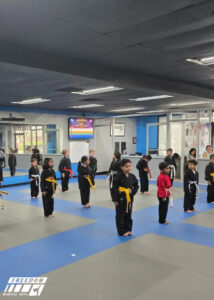
Responsibility is part of every class, even when students don’t realize it.
Students learn to arrive prepared.
They take care of their uniforms and equipment.
They wait their turn.
They encourage their classmates.
They accept corrections without making excuses.
They learn that their choices affect everyone around them.
These lessons aren’t taught through long lectures. They’re practiced every week through routines, partner drills, games, and everyday interactions.
Over time, those habits become second nature.
One Question to Ask This Month
If you want to reinforce responsibility at home, try asking one simple question at the end of each day:
“What was one responsible choice you made today?”
You may hear answers like:
“I remembered my homework.”
“I helped my little brother.”
“I cleaned up my toys.”
“I admitted when I made a mistake.”
Those are moments worth celebrating.
Because responsibility isn’t measured by one big accomplishment.
It’s built through dozens of small choices made every single day.
Growing Strong Leaders
At Freedom Martial Arts, our goal has never been to simply teach students how to punch and kick.
We want to help them become confident, respectful, and responsible young people who are prepared for challenges both on and off the mat.
Every class gives students another opportunity to practice leadership, accountability, and perseverance.
Those lessons stay with them long after class is over.
As we begin a new month together, we encourage every student to look for one new way to take responsibility at home, at school, and here at the studio.
Those small choices today become the habits that shape tomorrow’s leaders.
We can’t wait to see how our students grow this month.
References
American Academy of Pediatrics. (2024). Developmental Milestones: School-Age Children.https://www.healthychildren.org
Centers for Disease Control and Prevention. (2024). Positive Parenting Tips. https://www.cdc.gov/parents
Center on the Developing Child at Harvard University. (n.d.). Executive Function & Self-Regulation.https://developingchild.harvard.edu
Lakes, K. D., & Hoyt, W. T. (2004). Promoting self-regulation through school-based martial arts training. Applied Developmental Psychology, 25(3), 283-302.