










“My child knows how to say ‘Yes ma’am’… but they still roll their eyes when I ask them to clean their room.”
Sound familiar?
For many parents, respect feels confusing.
We teach our children to use polite words, make eye contact, and say “please” and “thank you.” Those things certainly matter. Manners are important.
But manners and respect aren’t the same thing.
A child can answer, “Yes sir,” while completely ignoring what was asked five minutes later.
They can say “thank you” while being unkind to a sibling.
They can be perfectly polite around adults yet struggle to accept correction, lose gracefully, or take responsibility when they’ve made a mistake.
Those situations remind us that respect isn’t simply about words.
It’s about character.
Respect Has Changed
For many adults, respect was often taught as obedience.
“Because I said so.”
“Don’t talk back.”
“Do as you’re told.”
While structure and clear expectations are important, research over the past several decades has shown that children thrive when respect becomes a two-way relationship rather than a one-way demand. Children respond best when adults provide clear expectations while also modeling kindness, consistency, and mutual respect. This parenting approach, often called authoritative parenting, consistently produces better long-term outcomes than either harsh authoritarian discipline or overly permissive parenting.
That doesn’t mean children should always get a vote.
It means they learn respect because they experience respect.
What Respect Actually Looks Like
Respect isn’t just talking politely.
It’s…
Listening the first time.
Accepting correction without falling apart.
Waiting your turn.
Taking care of equipment that belongs to everyone.
Helping someone who is struggling.
Owning your mistakes instead of making excuses.
Keeping promises you make to yourself.
Respect isn’t about making adults happy.
It’s about learning to value people, responsibilities, and yourself.
Researchers studying how children develop respect found that it grows alongside empathy, moral understanding, and the ability to recognize the value of other people. It develops over time through repeated experiences, conversations, and examples rather than through lectures alone.
The Hardest Kind of Respect
In our experience, one of the hardest forms of respect for children isn’t respecting adults.
It’s respecting themselves.
Self-respect shows up when no one is watching.
Practicing even when it’s difficult.
Trying again after failing.
Admitting, “I was wrong.”
Walking away from friends making poor decisions.
Doing homework before video games.
Choosing effort over excuses.
Children with healthy self-respect don’t believe they’re perfect.
They believe they’re capable of improving.
That’s a huge difference.
Why Correction Matters
One of the biggest misconceptions we hear is:
“I don’t want my child to lose confidence.”
Neither do we.
Confidence isn’t pretending mistakes don’t happen.
Real confidence comes from knowing you can recover from mistakes.
Every correction is an opportunity.
A child who hears feedback, adjusts, and improves is building resilience.
A child who avoids correction misses opportunities to grow.
Effective discipline isn’t about punishment.
Its purpose is helping children develop self-discipline, emotional maturity, and an internal sense of responsibility. Research consistently shows that discipline works best when it’s firm, fair, consistent, and built on mutual respect rather than fear or humiliation.
How Martial Arts Teaches Respect
One of the reasons families choose martial arts is because respect isn’t reserved for a weekly lesson.
It’s woven into everything we do.
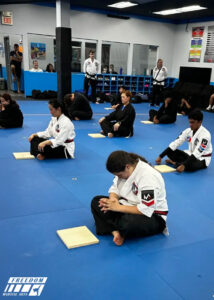
Students bow before entering the training floor, not because the movement itself is magical, but because it reminds them to enter class with focus.
They thank their partners after drills.
They help younger students.
They wait patiently for instructions.
They learn to control powerful techniques.
They accept corrections.
They celebrate teammates’ successes.
They lose.
They win.
They learn from both.
None of those moments alone creates character.
But together, practiced week after week, they begin to shape habits that carry into school, sports, friendships, and eventually the workplace.
It’s also important to be honest about what the research says. Martial arts alone is not a magic solution for behavior. Recent reviews suggest that simply participating in martial arts does not automatically improve aggression or prosocial behavior. Instead, the biggest difference comes from programs that intentionally teach values like respect, emotional regulation, self-control, and positive relationships alongside physical skills.
That’s why the culture inside a school matters just as much as the techniques being taught.
Four Ways Parents Can Build Respect At Home
1. Model it.
Children notice how we speak to waiters, teachers, coaches, cashiers, and each other.
Respect is often caught before it’s taught.
2. Correct the behavior, not the child.
Instead of:
“You’re so disrespectful.”
Try:
“That choice wasn’t respectful.”
Children need to know behavior can change.
3. Celebrate respectful moments.
Don’t only notice problems.
Point out when your child:
Held the door.
Helped a sibling.
Accepted correction.
Waited patiently.
Small moments deserve recognition.
4. Give responsibilities.
Respect grows through ownership.
Simple jobs like feeding a pet, putting away sports equipment, helping set the table, or remembering their own backpack teach children that their actions matter.
The Goal Isn’t Perfect Kids
No child is respectful all the time.
No adult is either.
The goal isn’t perfection.
The goal is progress.
Every conversation.
Every correction.
Every opportunity to apologize.
Every chance to try again.
Those small moments are where character is built.
At Freedom Martial Arts, we believe belts measure martial arts progress.
Character measures something far more important.
And respect is one of the foundations that supports it.
References
Malti, T., Peplak, J., & Zhang, L. (2020). The Development of Respect in Children and Adolescents. Monographs of the Society for Research in Child Development, 85(3).
Canadian Paediatric Society. (2004). Effective Discipline for Children.
Parents. (2020). How to Practice Positive Discipline at Home.
Deng, L., Ma, X., & Luo, Q. (2026). Martial Arts Training and Aggressive Behavior in Children and Adolescents: A Systematic Review of Longitudinal Evidence and Psychological Processes. Frontiers in Public Health.