










As we move into summer, one of the biggest challenges for both kids and adults is maintaining momentum once routines begin changing.
School schedules disappear.
Vacations happen.
Bedtimes shift.
Motivation comes and goes.
That is why our focus for June at Freedom Martial Arts is Momentum and Consistency.
Because the truth is, momentum is not magic.
It is usually the result of consistent action repeated over time.
Psychologist James Clear talks about this idea in Atomic Habits, explaining that long-term growth is built through small repeated behaviors that gradually become automatic (Clear, 2018).
Researchers studying habit formation found something similar. In a study published in the European Journal of Social Psychology, researchers discovered that repeated behaviors performed consistently in stable routines eventually become more automatic and require less effort to maintain (Lally et al., 2010).
That matters a lot for children.
Most kids think confidence comes first.
Then they will try harder.
Then they will stay disciplined.
Then things will become easier.
But most of the time, growth works the opposite way.
Action creates confidence.
Consistency creates momentum.
One class turns into familiarity.
Familiarity turns into comfort.
Comfort turns into confidence.
Over time, students begin:
• recovering from mistakes faster
• reacting more confidently
• staying engaged longer
• handling frustration better
• building stronger emotional control
Research on structured extracurricular activities has consistently shown positive effects on self-discipline, resilience, emotional regulation, and confidence in children and adolescents (Mahoney et al., 2005).
That becomes especially important during summer months.
Research on summer learning loss has shown that students often experience academic and behavioral regression when structure and engagement disappear entirely during the summer (Cooper et al., 1996).
That does not mean summer should feel stressful or overloaded.
But it does mean continued movement matters.
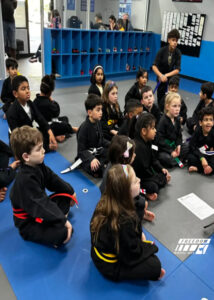
Martial arts gives students structure, challenge, accountability, physical activity, teamwork, and problem-solving during a time when many routines start disappearing.
And honestly, one of the biggest differences we see between students who continue growing and students who struggle long-term is not talent.
It is consistency.
The students who keep showing up.
Keep trying.
Keep adjusting.
Keep moving forward even when motivation changes.
That is what creates momentum.
And over time, momentum creates growth that becomes impossible to ignore.
References
Clear, J. (2018). Atomic Habits: An Easy & Proven Way to Build Good Habits & Break Bad Ones. Avery.
Cooper, H., Nye, B., Charlton, K., Lindsay, J., & Greathouse, S. (1996). “The Effects of Summer Vacation on Achievement Test Scores: A Narrative and Meta-Analytic Review.” Review of Educational Research, 66(3), 227–268.
Lally, P., van Jaarsveld, C. H. M., Potts, H. W. W., & Wardle, J. (2010). “How Are Habits Formed: Modelling Habit Formation in the Real World.” European Journal of Social Psychology, 40(6), 998–1009.
Mahoney, J. L., Larson, R. W., & Eccles, J. S. (2005). Organized Activities as Contexts of Development: Extracurricular Activities, After-School and Community Programs. Lawrence Erlbaum Associates.