










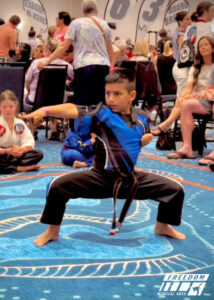
There is a moment in every child’s development that changes something internally.
It’s the moment their name is called.
Not when they’re practicing quietly.
Not when they’re blending into the group.
Not when no one is watching.
But when it’s their turn.
These spotlight moments feel different.
Heart rate rises.
Breathing shifts.
Muscles tighten.
Awareness sharpens.
Parents sometimes interpret this as anxiety. In reality, this response is the body preparing for performance.
The Science Behind Stress and Performance in Children
According to the American Psychological Association, moderate stress activates attention systems in the brain, increasing alertness and focus when children feel supported and prepared (APA, 2023). In manageable doses, stress enhances performance rather than harming it.
This principle aligns with the Yerkes–Dodson Law (1908), which demonstrates that performance improves with moderate physiological arousal. Too little stimulation leads to disengagement. Too much leads to overwhelm. But in the middle space — supported challenge — growth happens.
The presence of nerves is not the problem.
The response to them is what shapes development.
Courage Is Action Under Visibility
Courage is often misunderstood.
It is not calmness.
It is not the absence of nerves.
It is not confidence before action.
Courage is action under visibility.
When a child steps forward for belt testing, answers a question in class, performs a technique in front of peers, or volunteers to lead a drill, they are strengthening something deeper than skill.
They are building performance resilience.
They are training their nervous system to stay engaged under pressure.
And that changes identity over time.
How Structured Challenge Builds Emotional Regulation
The Harvard Center on the Developing Child explains that children build stronger executive function and emotional regulation skills when exposed to manageable stress within supportive environments. This “positive stress” strengthens neural pathways related to self-control, adaptability, and resilience.
In real-life terms, that means every time a child:
-
Performs alone during testing
-
Waits in a sparring stance for instruction
-
Speaks in front of peers
-
Makes a mistake publicly and continues
-
Pushes through nerves instead of stepping back
They are strengthening the brain systems responsible for confidence and leadership.
Repeated exposure to structured challenge teaches the brain: “I can handle this.”
That lesson compounds.
Why Spotlight Moments Matter for Leadership Development
Leadership is not built in comfort.
It is built in response.
When it’s your turn, you move.
At first, that movement feels uncomfortable.
Then it feels practiced.
Eventually, it becomes natural.
Over time, those small courageous decisions shape identity.
Children who repeatedly step forward under observation begin to see themselves differently. They no longer identify as “someone who gets nervous.” They identify as someone who acts anyway.
That identity carries far beyond martial arts, into classrooms, sports teams, friendships, presentations, interviews, and adult responsibility.
Building Courage Through Supported Challenge
March is about Courage.
Not loud courage.
Not dramatic courage.
The quiet kind.
The kind that steps forward when the name is called.
When children are given structured opportunities to perform, supported by instructors and family, they build confidence that lasts. They learn that nerves are not a stop sign.
They are a signal.
And when it’s their turn, they move.
Sources
American Psychological Association. (2023). Stress and Performance in Youth.
Harvard Center on the Developing Child. Supportive Relationships and Positive Stress.
Yerkes, R. M., & Dodson, J. D. (1908). The Relation of Strength of Stimulus to Rapidity of Habit Formation.